


THE PRACTICE TEST
Practice test at a glance
- Questions
- 500
- Format
- Multiple choice
- Access
- 2 years
- Price
- $19.99
- Answers
- Included
- Explanations
- Included
About these practice questions
These practice questions will help you prepare for the AMT MLS exam.
This practice test contains 500 practice questions covering the nine sections of the AMT MLS exam:
- General Laboratory
- Chemistry
- Hematology
- Coagulation and Hemostasis
- Immunology and Serology
- Immunohematology
- Blood Banking and Transfusion Services
- Microbiology
- Urinalysis and Body Fluids
All questions have been carefully designed to reflect the questions on the real exam, to help you prepare and get a passing grade.
GET FULL ACCESS
Unlock the full practice test
ONLINE ACCESS
Unlock all 500 practice questions, answers and explanations.
- Immediate access after payment
- One question at a time in practice mode
- Jump directly to any question
- One-time payment
We'll send your purchase information to this address.
Payment is processed by PayPal.
TRY IT FIRST
Sample practice questions
Try some of the questions before buying. Answers and explanations are available with online access.
Section 1: General Laboratory
Apply the tourniquet Clean the site Identify the patient Before drawing the patient's blood, first make sure you have the right patient.Insert the needle
Applying pressure to the puncture site Asking the patient to form a fist Puncturing straight through the vein A hematoma is a swollen area at the venipuncture site caused by blood leaking into the surrounding tissue. It can occur if the needle passes through the vein and out the other side, causing blood to leak into the tissue.Removing the tourniquet before removing the needle Removing the needle before releasing the tourniquet can cause a hematoma, not the other way around.
A needle stick injury Adulteration of the specimen Bacterial contamination Hemolysis of the specimen Pulling the plunger up too quickly can create excessive negative pressure in the syringe, causing red blood cells to rupture, which is called hemolysis. Hemolyzed samples can lead to inaccurate test results, especially for tests that require the analysis of serum or plasma components.
15−30 degrees When performing venipuncture, the needle should enter the skin at a low angle (15−30 degrees). A higher angle risks the needle going through the vein or hitting a nerve.30−45 degrees 45−60 degrees 60−75 degrees
Green, lavender, light blue Green, light blue, lavender Lavender, green, light blue Light blue, green, lavender The light blue top tube has a defined amount of sodium citrate, so it must be taken before other tubes containing additives. Lavender tubes should be taken after green tubes. This is because lavender tubes contain EDTA, which is high in potassium. If EDTA contaminates the green top tube, it could make the patient's potassium levels seem higher than they are.
Albumin Bilirubin Bilirubin is photosensitive, meaning it breaks down when exposed to light. To prevent this, blood samples for bilirubin testing must be protected from light after collection, for example by using an amber tube or wrapping the tube in foil.Iron Phosphate
5 grams of solute dissolved in 100 mL of solution w/v stands for weight/volume. It is used for solid solutes dissolved in liquid solvents.- Weight refers to the weight of the solute and is measured in grams.
- Volume refers to the final volume of the solution and is measured in mL.
5 grams of solute dissolved in 100 mL of solvent 5 mL of solute dissolved in 100 mL of solution 5 mL of solute dissolved in 100 mL of solvent
Concentration × volume The formula for calculating concentration is:concentration = solute mass/solution volume This can be rearranged as:solute mass = concentration × volume Volume + concentration Volume − concentration Volume/concentration
Heparin Plasma When centrifuged, uncoagulated (unclotted) blood separates into:- plasma (the straw-colored liquid layer)
- buffy coat (white blood cells and platelets)
- red blood cells
Serum Serum only appears when blood has clotted.Whole blood
Bacillus subtilis Bacillus subtilis is a relatively harmless bacterium and would be handled in a BSL-1 lab, not a BSL-3 lab.Escherichia coli Escherichia coli is handled in BSL-1 or BSL-2 labs, not BSL-3 labs.Mycobacterium tuberculosis Biosafety level 3 (BSL-3) laboratories handle pathogens that cause serious and potentially lethal infections via inhalation, such as Mycobacterium tuberculosis.Staphylococcus aureus Staphylococcus aureus is typically handled in BSL-2 labs, not BSL-3 labs.
10–15 seconds 25–30 seconds 5–10 minutes 30–60 minutes Vacutainers may contain clot activators (which speed up clotting) or anticoagulants (which prevent clotting). However, glass red-top tubes contain no additives, so the blood clots naturally. Blood collected in a glass red-top tube takes 30–60 minutes to clot. The tube must be undisturbed during this time to allow the clot to form. Once the clot has formed, the sample is centrifuged to separate the serum from the rest of the sample.
Erythrocyte sedimentation rate Hemoglobin International normalized ratio Warfarin is a medication used to prevent blood clots. Patients taking warfarin require laboratory testing to monitor the effectiveness of the medication. These tests measure how long it takes blood to clot. One such test is the prothrombin time (PT). When used to monitor warfarin therapy, prothrombin time results are reported as the international normalized ratio (INR).Partial thromboplastin time
Plan Do The PDCA cycle (Plan–Do–Check–Act) is a four-step process for continuous improvement. The four steps are:- Plan: Identify the problem, analyze it, and develop a solution.
- Do: Implement the solution on a small scale.
- Check: Evaluate the results of the experiment.
- Act: Standardize or abandon the solution based on the results.
Check Act
targeted technical total TQM stands for Total Quality Management, an approach to delivering quality and continuous improvement.traditional
The closeness of a result to the first standard deviation The closeness of a result to the median value The closeness of a result to the true value The repeatability of a procedure Precision refers to the closeness of results when a procedure is tested repeatedly. A test with high precision gives nearly the same result each time, even if the result is wrong.
Accuracy Accuracy is how close a measurement is to the real value.Precision Precision is how close repeated measurements are to each other.Reliability Reproducibility
Inspections to prevent work-related accidents Testing for illegal drugs in a biological sample Tests to ensure workers have the skills and knowledge to perform their jobs The testing of unknown samples sent to the laboratory Proficiency testing is when a program sends unknown samples to laboratories to test. The labs return their results, which the program then grades. This helps labs check if their testing methods are accurate.
Cycle Outlier An outlier is an extreme data point that is much higher or lower than other data points.Shift A shift is when the mean suddenly changes up or down on a control chart. Seven or more consecutive points on the same side of the mean demonstrate a shift.The circled area in the image below shows a shift. 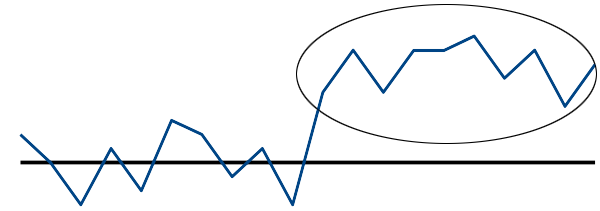
Trend A trend is a steady increase or decrease in values over time.
Determining how well a laboratory test is working Laboratories use Levey-Jennings charts for quality control. The charts visually display the results of control samples over time. By analyzing the charts, technicians can assess the precision and accuracy of laboratory tests. Trends, shifts, and outliers signal potential problems with the testing process.The image below shows an example of a Levey-Jennings control chart. 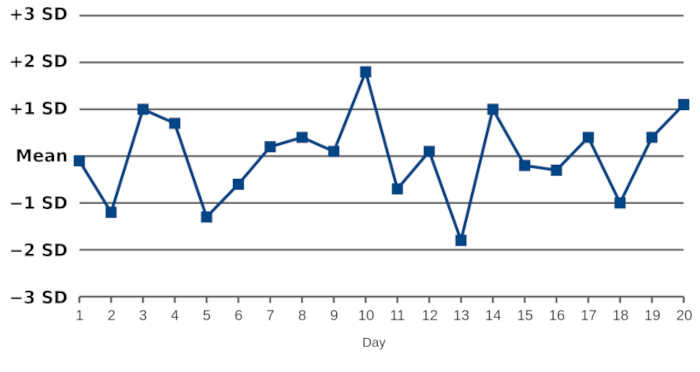
Logging the daily calibration of laboratory instruments Summarizing monthly performance statistics Tracking the expiration dates of test reagents
Blood Ketones are made when the body breaks down fats for energy instead of glucose. High ketone levels may be a sign of diabetes. Ketone testing can be performed using urine, breath, and blood, although blood is preferred.Semen Stool Sweat
Ready for all 500 questions?
Unlock the full practice testPREFER PAPER?
Get the printed book
The practice questions and answers are also available as a physical book from Amazon.com.

About the AMT MLS exam
What is the AMT MLS exam?
The AMT MLS (Medical Laboratory Scientist) certification exam is set by the American Medical Technologists (AMT). Passing the exam proves to employers that you can work in a laboratory as a medical laboratory scientist.
The exam contains 210 questions and lasts 3.5 hours. All questions are multiple-choice.
Exam eligibility
Before deciding to take the exam, first make sure you're eligible. There are six eligibility routes for the AMT MLS exam:
- Recent MLS graduate: Graduated with a bachelor's degree in medical laboratory science (or equivalent) within the past five years.
- MLS graduate + experience: Graduated with a bachelor's degree in medical laboratory science (or equivalent) and worked in a clinical laboratory for at least one year.
- Graduate + experience + MLT program: Graduated with a bachelor's degree, worked in a clinical laboratory for at least one year, and completed an MLT program.
- Graduate + experience + military: Graduated with a bachelor's degree, worked in a clinical laboratory for at least one year, and completed a 50-week US military medical laboratory training program.
- Graduate + experience + courses: Graduated with a bachelor's degree, worked in a clinical laboratory for at least one year, and completed 48 semester hours of clinical laboratory science or related fields.
- Graduate + post-graduate + courses: Graduated with a bachelor's degree, completed a post-bachelor medical laboratory science training program, and completed 48 semester hours of clinical laboratory science or related fields.
You must meet the requirements of at least one of these routes to take the AMT MLS exam. For more details, visit the official AMT site at AmericanMedTech.org.
Applying for the exam
The easiest way to apply for the AMT MLS exam is online. Go to the AMT website (americanmedtech.org), and under Certification, click Apply/Check Status. Scroll down and click the Apply Today button to begin the application process.
The exam fee is $245 if you're living in North America and $225 if you're living outside North America.
Once you've submitted your application, it typically takes 1-2 weeks for the AMT to process it. If the AMT approves your application, you'll have up to one year to schedule and complete your exam.
What if I need to cancel or reschedule the exam?
You can cancel or reschedule your exam by contacting Pearson Vue at least 24 hours before your exam starts. There is no charge for canceling or rescheduling, however, the exam fee is non-refundable.
What to bring to the exam
You must bring two valid forms of ID with you, one of which must have your photo.
Acceptable photo IDs are:
- Driver’s License
- Passport
- Military Identification
- State Identification Card
Calculators aren't allowed in the exam.
What's the exam like?
On the exam day, you'll need to go to your testing center. Make sure to arrive 30 minutes before the exam starts because you'll need time to check in and show your ID.
You'll be taken to a computer where you'll do the exam. The exam is 3 hours and 30 minutes long and consists of 210 multiple-choice questions. There are no breaks.
What score do I need to pass?
There is no set number of questions you must answer to pass. Instead, each question is worth a certain number of points depending on its difficulty. Easy questions are worth fewer points and hard questions are worth more points. To pass, you must earn 70 points out of 100.
How do I get my results?
You'll get your result immediately after finishing the exam. The computer will tell you if you passed or failed.
The testing center will also give you a paper copy of your results before you leave.
What if I fail the exam?
If you fail the exam, you can take it again after 45 days. To retake the exam, contact AMT at 847/823-5169 or complete the Examination Retake Form and submit it to documents@americanmedtech.org. You'll also need to pay a retesting fee.
Exam structure
The AMT MLS exam is divided into nine Work Areas:
- General Laboratory
- Chemistry
- Hematology
- Coagulation and Hemostasis
- Immunology and Serology
- Immunohematology
- Blood Banking and Transfusion Services
- Microbiology
- Urinalysis and Body Fluids
1. General Laboratory
The first Work Area, General Laboratory, is worth 14.3% of the exam and consists of 30 questions. It will test your knowledge of:
- laboratory quality
- laboratory laws and regulations
- laboratory safety
- laboratory equipment
- laboratory mathematics
- microscopes
- patient identification
- specimen collection (e.g. phlebotomy)
- specimen handling
- patient identification
- waived testing
2. Chemistry
The second Work Area, Chemistry, is worth 21.4% of the exam and consists of 45 questions. It will test your knowledge of:
- instruments used for clinical chemistry (spectrophotometer, osmometer, electrophoresis, etc.)
- the kidney
- how the kidney works
- common kidney tests (e.g. glomerular filtration rate)
- the liver
- how the liver works
- bilirubin and jaundice
- common liver tests
- carbohydrate metabolism
- diabetes
- glucose tests
- protein analysis
- plasma proteins (albumin, globulins, and fibrinogen)
- protein tests (e.g. protein electrophoresis)
- enzymes
- cP, ALT, GGT, ALP, AST, CK, LD, amylase, lipase
- enzymes elevated in liver disease
- pancreas enzymes
- cardiac enzymes and cardiac marker tests (e.g. troponin and myoglobin)
- phosphatases
- endocrinology
- glands and hormones of the endocrine system
- thyroid function tests (thyroxin, TBG, free T3, free T4, TSH)
- growth hormones
- reproductive hormones (FSH, LH, estriol, estradiol, estrogen,
- testosterone, 17-ketosteroids)
- pregnancy hormones (HPL, HCG, prolactin)
- lipids
- cholesterol, LDL, HDL
- water and electrolytes
- electrolyte reference ranges
- causes of electrolyte imbalances
- the definitions of hyponatremia, hypernatremia, hypokalemia, and hyperkalemia
- acid-base balance
- arterial blood gas analysis
- blood pH and how the body maintains the pH of blood (the bicarbonate and carbonic acid system)
- cerebrospinal fluid
- other chemistry procedures
- tumor markers
- drugs testing
- fetal wellness (fibronectin, AFP, L/L ratio)
3. Hematology
The third Work Area, Hematology, is worth 15.2% of the exam (32 questions). It will test your knowledge of:
- red blood cells
- how red blood cells work
- red blood cell tests (e.g. erythrocyte sedimentation rate, hematocrit)
- white blood cells
- types of white blood cells
- white blood cell tests
- platelets
- how platelets work
- platelet tests
- blood diseases (e.g. anemia)
- preparing and staining blood slides
4. Coagulation and Hemostasis
The fourth Work Area, Coagulation and Hemostasis, is worth 7.1% of the exam and consists of 15 questions. It will test your knowledge of:
- coagulation procedures
- prothrombin time (PT)
- activated partial thromboplastin time (aPTT)
- thrombin time (TT)
- fibrinogen, D-dimer, fibrin degradation test, fibrin split product test, heparin assay, mixing studies, factor testing, platelet function testing
- coagulation specimens (blue top tubes)
- anticoagulants
5. Immunology and Serology
The fifth Work Area, Immunology and Serology, is worth 3.8% of the exam and consists of 8 questions. It will test your knowledge of:
- the immune system. White blood cells? T cells and B cells. Autoimmune conditions.
- antigens and antibodies
- syphilis blood tests
- other tests (HIV, mono, pregnancy, C-reactive protein (CRP))
- hypertonic and hypotonic solutions
6. Immunohematology
The sixth Work Area, Immunohematology, is worth 10.5% of the exam and consists of 22 questions. It will test your knowledge of the theoretical aspects of blood transfusions, such as:
- blood typing
- the immune response
- blood compatibility testing
- the Rh immune globulin
7. Blood Banking and Transfusion Services
The seventh Work Area, Blood Banking and Transfusion Services, is worth 8.1% of the exam and consists of 17 questions. It will test your knowledge of the practical aspects of blood transfusion, such as blood banking practices.
You will need to know about:
- blood banking terms like directed donation, autologous transfusion, and anticoagulant
- blood products such as cryoprecipitate, packed red cells, and platelets
- blood donor eligibility and collection requirements
- blood storage conditions and labeling requirements
- therapeutic phlebotomy
- regulations for blood bank operations, including daily inspections and temperature checks
- policies for blood product storage, issuance, and returns
- transfusion reactions and transfusion-transmitted infections
- special blood product needs (e.g., CMV-negative) and crossmatching requirements
8. Microbiology
The eighth Work Area, Microbiology, is worth 14.8% of the exam and consists of 31 questions. It will test your knowledge of:
- bacteriology
- virology
- parasitology
- mycology
- microbial stains (acid-fast stains, fluorescent stains, Gram's stain, Giemsa and Wright's stains, India ink stain)
- agar media
9. Urinalysis and Body Fluids
The final Work Area, Urinalysis and Body Fluids, is worth 4.8% of the exam and consists of 10 questions. It will test your knowledge of:
- urine
- urine analysis
- the kidneys
- other body fluids (cerebrospinal fluid, gastric contents, etc.)
Focus your study efforts on General Laboratory, Chemistry, Hematology, Immunohematology, and Microbiology. These five work areas are together worth 76% of the exam. The other four work areas — Coagulation and Hemostasis, Immunology and Serology, Blood Banking and Transfusion Services, and Urinalysis and Body Fluids — are together only worth 24% of the exam and are therefore less important.