


THE PRACTICE TEST
Practice test at a glance
- Questions
- 300
- Format
- Multiple choice
- Access
- 2 years
- Price
- $29.99
- Answers
- Included
- Explanations
- Included
About these practice questions
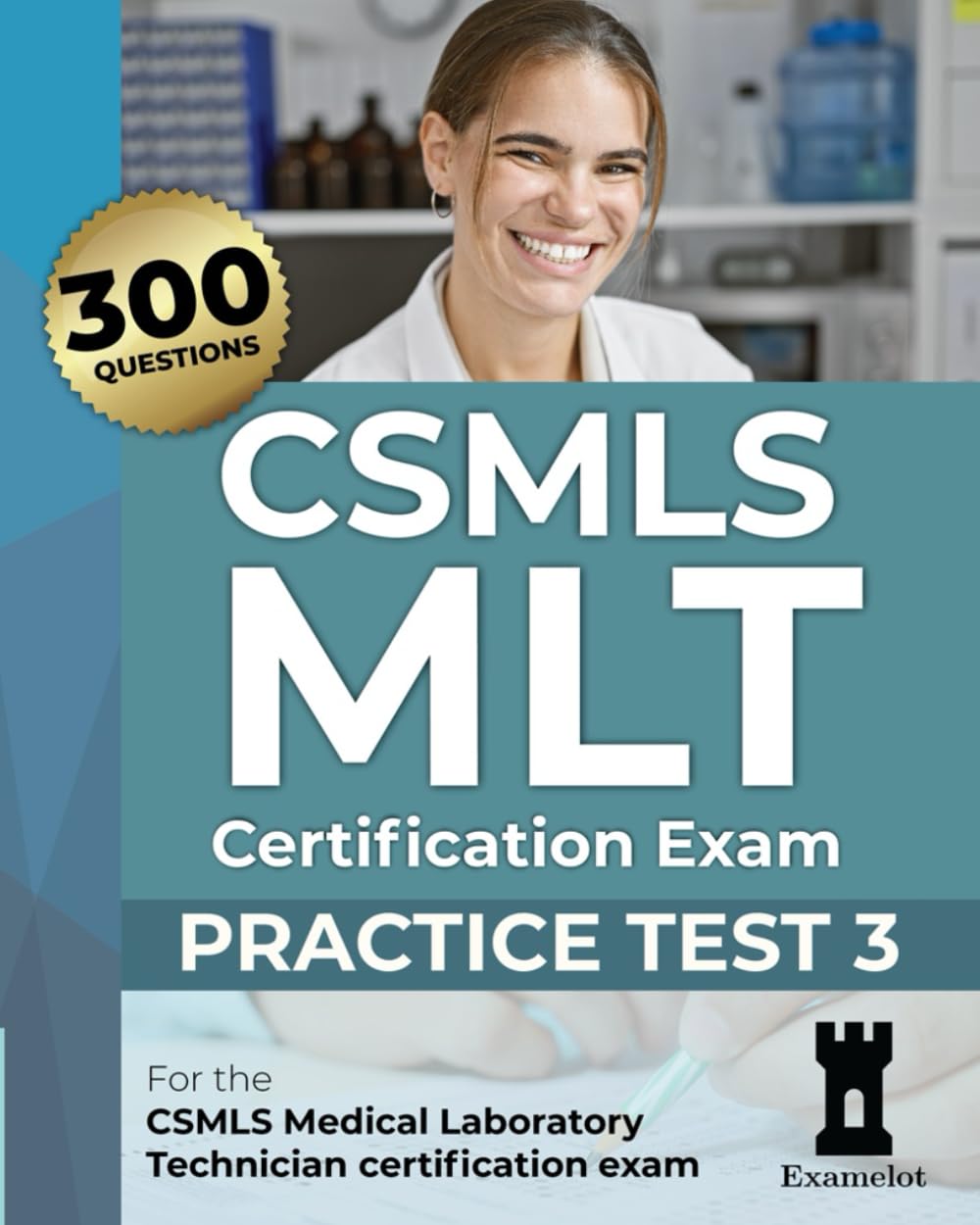
These practice questions will help you prepare for the CSMLS MLT exam.
This practice test contains 300 practice questions covering the eight sections of the CSMLS MLT exam:
- Safe Work Practices
- Data and Specimen Collection and Handling
- Analytical Processes
- Interpretation and Reporting of Results
- Quality Management
- Critical Thinking
- Communication and Interaction
- Professional Practice
All questions have been carefully designed to reflect the questions on the real exam, to help you prepare and get a passing grade.
GET FULL ACCESS
Unlock the full practice test
ONLINE ACCESS
Unlock all 300 practice questions, answers and explanations.
- Immediate access after payment
- One question at a time in practice mode
- Jump directly to any question
- One-time payment
We'll send your purchase information to this address.
Payment is processed by PayPal.
TRY IT FIRST
Sample practice questions
Try some of the questions before buying. Answers and explanations are available with online access.
Section 1: Safe Work Practices
UN 2814 – Infectious Substance, Category B, Affecting Humans UN 3291 – Clinical Waste, Category B UN 3373 – Biological Substance, Category B The proper shipping name of a Category B infectious substance is Biological Substance, Category B and it is shipped under UN 3373. The shipping name must appear on the outer container.UN 3549 – Medical Waste, Category B, Affecting Humans
Canada Labour Code Part II of the Canada Labour Code is health and safety legislation for federally regulated workplaces. This section covers topics like hazard prevention, safety training, and the process for handling workplace accidents or dangers. It aims to create safer work environments. The code only applies to workplaces regulated by the federal government. Most workplaces fall under the legislation of a province or territory instead, such as the Occupational Health and Safety Act in Ontario.Canadian Environmental Protection Act Public Service Employment Act Workplace Hazardous Materials Information System
Canadian Environmental Protection Act Food and Drug Act Health of Animals Act Human Pathogens and Toxins Act The Human Pathogens and Toxins Act (HPTA) is the primary Canadian law that protects the public from dangerous microorganisms and substances. The HPTA regulates the possession, use, and storage of human pathogens and toxins, ensuring they are handled safely and responsibly.
In airtight containers Ethers form explosive peroxides when exposed to air and light. Therefore, ethers must be stored in the dark and in airtight containers.In the light In the refrigerator Underwater
in a fume hood in a poorly ventilated area Mercury vapours are toxic, and inhalation can lead to mercury poisoning. Mercury spills are especially dangerous in poorly ventilated areas.near sources of ignition near the flammable storage cabinet
Chlorine bleach Chlorine reacts with the ammonia in urine to form chloramine. Chloramine is a toxic gas that can cause coughing, irritation, and, in very severe cases, death. For this reason, chlorine-based disinfectants should not be used on urine spills.Hydrogen peroxide Isopropyl alcohol Povidone-iodine
Clean up the spill Move everyone to fresh air Turn off the flame Acetone is highly flammable. Your first action in the event of an acetone spill should be to remove sources of ignition to prevent a fire.Wash eyes with water
Pour disinfectant onto the spill Put on PPE The typical steps for cleaning up a blood spill are:- Put on PPE such as gloves (this will protect you from contamination as you clean up the spill)
- Soak up as much of the spill as possible with disposable towels
- Apply the disinfectant to the spill and let it soak
- Clean the spill again with disposable towels
- Decontaminate any reusable equipment, such as dustpans and brushes
- Remove the PPE and wash your hands
Record the incident in the incident book Wash your hands
Burns from hot steam When an autoclave cycle is finished, superheated steam is still inside the autoclave. Opening the door too soon allows this steam to escape, which can severely burn your skin, face, and eyes. Always check that the pressure gauge reads “0” before opening the door of an autoclave.Electrical shock Exposure to carbon monoxide Radiation exposure
Continued exposure to the substance could cause temporary incapacitation or injury The blue quadrant represents health hazards. A number 2 in this quadrant indicates a moderate hazard to human health, and that continued exposure to the substance could cause temporary incapacitation or injury.The substance can be ignited at normal temperatures The substance is unreactive with water The substance reacts with water in an unusual or dangerous way
Call emergency services If someone swallows a poisonous liquid, the priority is to get emergency help immediately and follow the product’s safety instructions.Give the lab assistant water to drink Giving the lab assistant water to drink can help dilute the chemical in the body, but the first priority is to call emergency services or a poison control centre.Place the lab assistant in the recovery position Placing the lab assistant in the recovery position would be appropriate if the person were unconscious, but in this case, the lab assistant is conscious.Take the lab assistant outside for fresh air Taking the lab assistant outside for fresh air would be appropriate if the lab assistant breathed in a dangerous chemical (exposure by inhalation), but not for ingestion.
Biosafety cabinet Fire extinguisher Fume hood Goggles Common PPE used for protection against non-ionizing UV radiation includes UV safety goggles, face shields, and gloves. Exposed skin should also be covered with clothing because UV radiation can burn skin.
2–3 3–4 4–5 5–6 In CPR, the recommended chest compression depth for adults is 5–6 cm (2 to 2.4 inches).
Give the patient a glass of water Give the patient a sugary drink The patient is wearing a diabetic medical bracelet, which means she has diabetes. The symptoms of a fast heart rate and rapid breathing are consistent with insulin shock, which occurs when a diabetic takes too much insulin, and their blood glucose levels fall too low. If the patient can swallow, you should give them a drink containing sugar, such as orange juice, cola, or sugar dissolved in water. If their blood glucose levels are low, it will help bring the levels back up to normal. The patient will also require emergency medical attention. If in doubt whether a patient's glucose levels are too high or too low, give the patient sugar anyway. A patient with high blood glucose (hyperglycemia) can withstand the extra sugar, whereas a patient with hypoglycemia needs sugar immediately to prevent possible brain damage or death.Give the patient time to recover on her own Inject the patient with insulin
Cardiac arrest The chain of survival is a series of actions that, when performed in order, increase the likelihood of survival from cardiac arrest.Diabetic coma Massive blood loss Stroke
Fill out an accident report form Go to a doctor or hospital emergency department Report the incident to your supervisor Wash the wound with soap and water While all the steps listed are important, the first step is to wash the wound with soap and water to remove pathogens and contaminants.
Absorbent spill pads Biohazard bags Cryogenic gloves Sterile gauze First aid kits contain items such as bandages, gauze, and antiseptic wipes to treat minor cuts, burns, and abrasions.
When the person has stopped breathing When the person is having a seizure When the person is unconscious When the person refuses care Never administer care to a casualty who explicitly refuses care. Casualties have the right to refuse first aid treatment.
5 compressions followed by 15 breaths 10 compressions followed by 10 breaths 20 compressions followed by 5 breaths 30 compressions followed by 2 breaths When performing CPR, give 30 chest compressions followed by 2 rescue breaths.
Apply a heating pad Hot water or a heating pad risks burning the affected area, since the patient may not be able to feel the heat correctly.Immerse his hands in hot water Loosely wrap his fingers in bandages When transporting a patient with frostbite, loosely wrap the affected area in bandages, clothing, or blankets. You can also tell the patient to keep the affected area next to their body, where it is warm.Rub his hands vigorously Vigorous rubbing can damage the affected area since frostbitten tissue is delicate.
Ready for all 300 questions?
Unlock the full practice testPREFER PAPER?
Get the printed book
The practice questions and answers are also available as a physical book from Amazon.com.
About the CSMLS MLT exam
What is the CSMLS MLT exam?
The CSMLS MLT Certification Exam is an examination for laboratory technologists in Canada. The exam is set by the CSMLS (Canadian Society for Medical Laboratory Science).
When is the CSMLS MLT exam?
The CSMLS MLT exam is held several times each year, typically in February, June, and October. The deadline for registration is two months before each exam. Check the current exam schedule on the CSMLS website, www.csmls.org.
How much does the CSMLS MLT exam cost?
The fee for the CSMLS MLT exam is based on your CSMLS membership status and whether you live in Canada. The exam fees are as follows:
| Canadian resident | Non-resident | |
|---|---|---|
| CSMLS member | $999 | $1,910 |
| Non-member | $1,285 | $2,210 |
There is a late fee if you book the exam within the last two weeks of registration. The late fee is $180 for CSMLS members and $185 for non-members.
What are the competencies on the exam?
The CSMLS MLT exam has 210 multiple-choice questions that cover eight competencies. These competencies are:
- Safe Work Practices
- Data and Specimen Collection and Handling
- Analytical Processes
- Interpretation and Reporting of Results
- Quality Management
- Critical Thinking
- Communication and Interaction
- Professional Practice
The following table shows the percentage distribution of the competencies assessed in the CSMLS MLT exam.
| Competency | Percentage of exam |
|---|---|
| 1. Safe Work Practices | 5–7% |
| 2. Data and Specimen Collection and Handling | 5–7% |
| 3. Analytical Processes | 30–35% |
| 4. Interpretation and Reporting of Results | 20–25% |
| 5. Quality Management | 20–25% |
| 6. Critical Thinking | 5–10% |
| 7. Communication and Interaction | 3–5% |
| 8. Professional Practice | 5–7% |